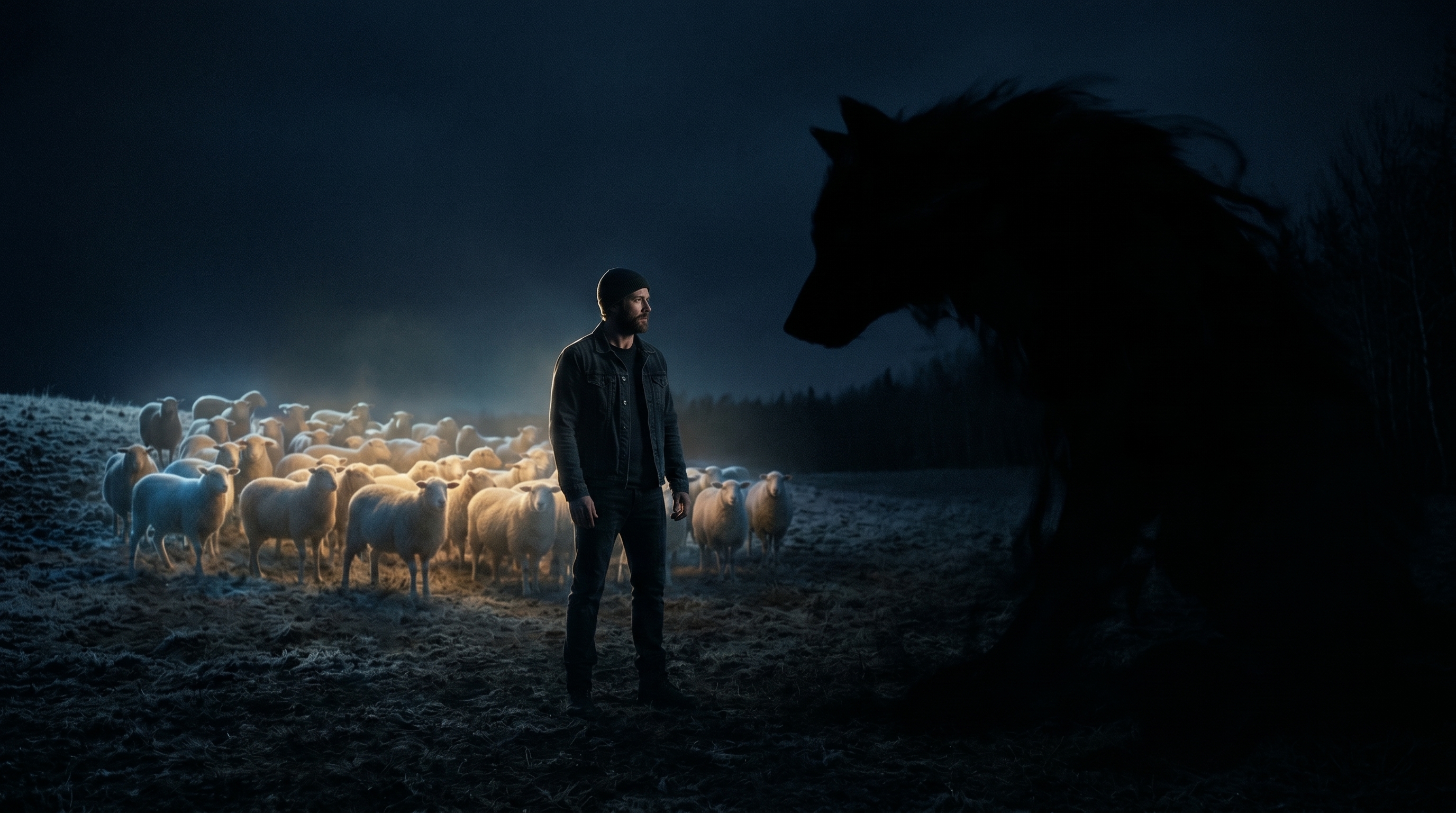
There is a particular sound a well-worn Bible makes when it falls open — not to a page you went looking for, but to the page it always seems to find on its own, where the spine has been broken by years of returning. In the book, I gave Lady Grace a Bible like that, the kind a person reads before dawn with coffee going cold beside them, because I have known people whose lives were quietly built on exactly that habit. When I wrote The Hunter of Wolves, I did not want Scripture to sit on top of the story as decoration. I wanted it underneath, holding the whole thing up.
I did not hang these verses on the story like ornaments on a tree. I planted them as roots, and the story grew up out of them.
So the verses you will find in the novel are not random or ornamental. Each one is doing a job. Some name the danger. Some arm the characters. Some are the hinge the entire plot swings on. What follows is a guided tour of the most important passages in the book and what each is actually doing in the story.
Key Takeaways
- Scripture in The Hunter of Wolves functions structurally — naming the danger, arming the characters, and turning the plot — rather than serving as decoration.
- The title itself is rooted in the Bible’s recurring imagery of wolves and sheep.
- Lady Grace’s life is built on the “warrior psalms,” especially the prayer that God “trains my hands for war.”
- The book’s view of spiritual conflict draws directly on Paul’s teaching that our weapons are “not of this world.”
- The hero’s pivotal decision quietly echoes one of Scripture’s most famous answers to a call.
- The climax turns on the mercy passages — above all, the promise that “mercy triumphs over judgment.”
- You do not need to know the Bible to follow the story, but recognizing the references deepens nearly every scene.
The Wolves and the Sheep: Where the Title Comes From
The title is the first biblical reference in the book, before a single chapter begins. Scripture is full of wolves and sheep. Jesus warns of false prophets who come in sheep’s clothing but are inwardly “ferocious wolves.” He sends His followers out “like sheep among wolves.” Paul cautions that “savage wolves” will come in among the flock. And running through all of it is the image of the Good Shepherd who lays down His life for the sheep and goes after the one that is lost.
The title itself is a sermon: a hunter who guards the sheep by going after the wolves.
That is the whole moral architecture of the novel compressed into four words. A hunter of wolves is not a predator. He is a shepherd’s weapon — someone who hunts what hunts the flock. I wanted readers to feel the inversion at the center of the book: the men who look most like wolves, badge or no badge, may be the true predators, while the real warrior may be the frail old woman everyone overlooks.
“He Trains My Hands for War”: The Psalms Behind Lady Grace
If you want to know who Grace is, read what she reads. Early in the story she opens her Bible to Psalm 144 and prays its astonishing opening — praise to the Lord who “trains my hands for war and gives my fingers skill for battle,” who is her rock, her fortress, her rescuer. I chose that psalm for her deliberately. Here is an elderly widow whose hands can barely hold a steering wheel, claiming that those same hands have been trained for war. The gap between how she looks and what she believes about herself is the engine of her character.
The same warrior-spirit runs through the kindred psalms of praise that arm the faithful for battle. I leaned on that tradition because it corrects a sentimental idea many of us carry — that gentleness and warfare are opposites. In Grace, they are the same thing. Her kindness is her combat.
Weapons Not of This World: The Armory of the Book
The clearest statement of the novel’s worldview comes when Grace recalls Paul’s words in 2 Corinthians — that though we live in the world, we do not wage war as the world does, for “the weapons we fight with are not the weapons of the world,” but have “divine power to demolish strongholds.” That single passage is the armory the whole book draws from.
Scripture in this book is never decoration. It is the marching orders the characters are actually following.
It pairs with the truth that our struggle is finally not against flesh and blood but against unseen powers — the conviction that lets the story layer its visible crime plot over an invisible war. When Cristoff’s pistol proves nearly useless against the thing actually hunting him, that is not a failure of plot. It is the passage made flesh: the real strongholds in this story can only be demolished by weapons the world does not recognize.
“This Charge I Entrust to You”: Scripture as Marching Orders
One of my favorite small moments comes when Grace leaves a note for the police along with her baked goods, and writes out part of Paul’s charge to Timothy — to wage “the good warfare.” It is an ordinary gesture, a card tucked beside some brownies, and yet she is quietly commissioning these officers as soldiers without their even knowing it.
That is how Scripture tends to operate in the book: not in thunder, but in handwriting on a card, in a verse remembered at a red light, in a prayer prayed over a stranger. Later, when the small band of the faithful gathers, the prayers stitched through that scene — that the Lord is God, that we are the sheep of His pasture, that if God is for us no one can stand against us, that no eye has seen a God like ours who acts for those who wait — are not filler. They are the characters arming themselves out loud before they march. And the reminder that “the prayer of a righteous person is powerful and effective” is, in this story, simply a statement of fact.
Through the Valley and Onto Eagles’ Wings
Two images from Scripture shape the geography of the book’s final movement. The first is the valley of the shadow — the twenty-third psalm’s dark ravine where one fears no evil only because Someone is present. I sent my characters quite literally into such a valley, into shadowed mountains where the danger is total, precisely so that the comfort of that psalm would have to be tested rather than merely quoted.
The second is the promise that those who hope in the Lord “will soar on wings like eagles.” When deliverance finally comes in the story, it comes on wings, and I wanted the reader who knows the verse to feel the echo without my having to point at it. The Scripture is doing the work underneath the action.
“Here Am I. Send Me.” — The Verse Hidden in a Decision
There is a moment when Hunter Cristoff, sitting in a meeting he has no business being qualified for, says four plain words: “Send me. I’ll go.” I wrote that line as a deliberate echo of the prophet Isaiah, who, when he heard the Lord ask whom He should send, answered, “Here am I. Send me!”
I did not flag the reference in the text, because the best biblical allusions in fiction are the ones a reader feels before they recognize. Cristoff is no prophet. He is a suspended, grieving detective. But the shape of his answer is the shape of every faithful person’s answer across Scripture — the willingness to be sent before knowing the cost. That single buried verse is, in many ways, the turning point of the entire plot.
“Mercy Triumphs Over Judgment”: The Scriptures at the Climax
Everything in the book finally bends toward two passages, and I will not spoil the scene they govern, only name them. The first is Jesus’ own words: “I desire mercy, not sacrifice. For I have not come to call the righteous, but sinners.” The second is from James: “Mercy triumphs over judgment.”
Mercy triumphs over judgment — three words that quietly overturn the entire genre.
A thriller is built to deliver judgment. The whole machinery of the form points toward a final reckoning. By placing those mercy texts at the hinge of the climax, I was trying to let Scripture do something the genre cannot do on its own — to reach down into the filth after the very person who has earned destruction, the way the cry of a hunted child reaching for a “Father” he has never met is answered in the book’s opening pages. That cry, too, is a reference: it is the Spirit-given word of adoption, the “Abba, Father” by which the lost are made sons.
Final Thought
The book closes the way it was always going to close — on its knees. The final pages rest on Zephaniah’s image of the Lord as a “Mighty Warrior who saves,” who rejoices over His people with singing; on Isaiah’s promise that the Lord waits to be gracious, and “blessed are all those who wait for Him”; and on Paul’s quiet command to let no debt remain “except the continuing debt to love one another.” I ended there on purpose. After all the danger and the chase and the unseen war, the last word of The Hunter of Wolves is not victory or vengeance. It is waiting, and singing, and love — and every one of those words I borrowed, gratefully, from a Book far older and far better than mine.
Discussion Questions
- The title draws on Scripture’s wolves-and-sheep imagery to invert who the real predator is. Where in your own world have you seen “wolves in sheep’s clothing”?
- Lady Grace’s life is built on a psalm claiming God “trains my hands for war.” How does that reframe what spiritual strength looks like in an ordinary, overlooked person?
- The book insists our truest weapons are “not of this world.” What might that mean practically for how a person confronts evil or injustice today?
- Cristoff’s “Send me. I’ll go” echoes Isaiah’s answer to God’s call. Have you ever said yes to something before you knew what it would cost?
- The climax turns on “mercy triumphs over judgment.” Do you find that a satisfying resolution, or a troubling one — and what does your reaction tell you about your own instincts toward justice and grace?
Frequently Asked Questions
How many Bible verses are in The Hunter of Wolves, and which translations are used? Scripture appears throughout — as chapter epigraphs, in characters’ prayers, and woven into the narration — drawn from several translations, including the NIV, ESV, NLT, NKJV, and KJV, used with permission.
Do I need to know the Bible to follow the story? No. The novel works as a thriller on its own. But many scenes carry a second layer of meaning for readers who recognize the references, and part of the pleasure for those readers is feeling the echoes underneath the action.
Where does the title come from biblically? It grows out of Scripture’s recurring imagery of wolves and sheep — false teachers as wolves in sheep’s clothing, believers sent out as sheep among wolves, and the Good Shepherd who protects the flock and seeks the lost.
What is the single most important verse to the book? If I had to choose one, it would be “mercy triumphs over judgment” from James, because the entire story finally bends toward that truth. Psalm 144’s “He trains my hands for war” is its close companion.
Are the Scripture quotations used accurately and in context? Yes. The verses are quoted faithfully from their translations and chosen to function in keeping with their biblical meaning — naming the spiritual conflict, arming the faithful, and pointing toward mercy.
Sources
- “ferocious wolves.” — https://www.biblegateway.com/passage/?search=Matthew%207%3A15&version=NIV
- “like sheep among wolves.” — https://www.biblegateway.com/passage/?search=Matthew%2010%3A16&version=NIV
- “savage wolves” — https://www.biblegateway.com/passage/?search=Acts%2020%3A29&version=NIV
- Good Shepherd — https://www.britannica.com/topic/Good-Shepherd
- Psalm 144 — https://www.biblegateway.com/passage/?search=Psalm%20144%3A1-2&version=NIV
- psalms — https://www.britannica.com/topic/Psalms
- 2 Corinthians — https://www.biblegateway.com/passage/?search=2%20Corinthians%2010%3A3-5&version=NIV
- “the good warfare.” — https://www.openbible.info/topics/good_warfare
- “the prayer of a righteous person is powerful and effective” — https://www.openbible.info/topics/prayer_of_the_righteous
- psalm’s — https://www.britannica.com/topic/Psalms
- “will soar on wings like eagles.” — https://www.openbible.info/topics/wings_like_eagles
- Isaiah — https://www.britannica.com/biography/Isaiah
- “Here am I. Send me!” — https://www.openbible.info/topics/here_am_i_send_me
- “Mercy triumphs over judgment.” — https://www.openbible.info/topics/mercy_triumphs_over_judgment