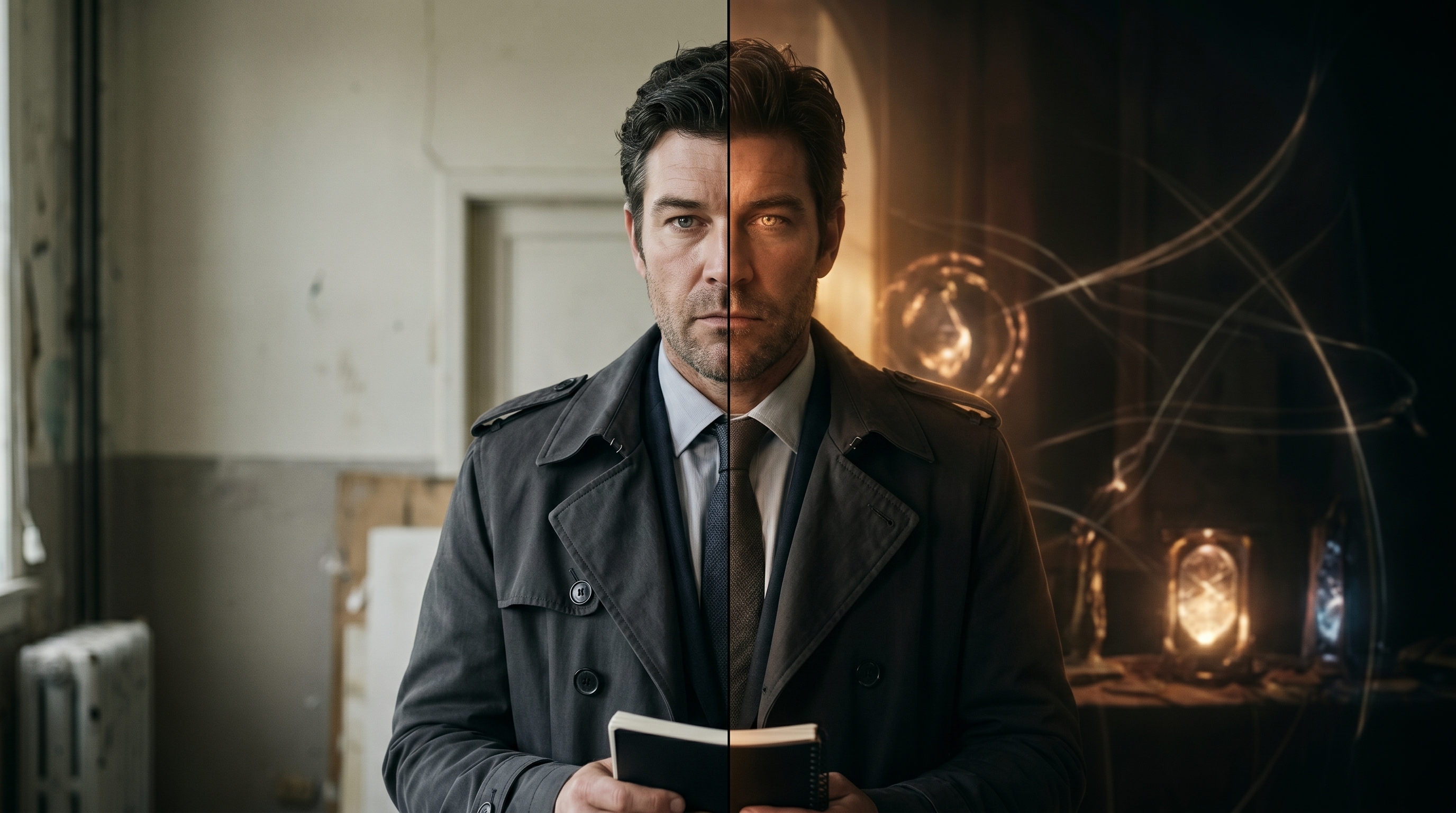
For a good stretch of my life, my days were governed by things I could prove. Chain of custody. Time stamps. The serial number on a weapon, the data on a phone, the testimony I could swear to before a judge. A detective lives in the world of the demonstrable, because in that world a single unsupported assumption can sink a case and let a guilty man walk. And then, in another season of my life, I worked in places and among people whose deepest realities could not be entered into evidence at all — places where the most important thing happening in a room was the very thing no camera could record. I have spent years in each of those worlds. The Hunter of Wolves is where they finally sat down at the same table.
I spent years dealing in evidence, and years dealing in the unprovable. This book is where those two halves of my life finally sat down together.
That meeting is what people mean when they call the book “crime fiction with a supernatural twist.” But the word twist undersells what I was after, and it hides the real craft problem at the center of a book like this. Marrying a hard procedural to genuine supernatural is easy to attempt and very easy to botch. Most attempts fail in one of two ways, and avoiding both was the whole game.
Key Takeaways
- The Hunter of Wolves blends a grounded police procedural with a genuine supernatural reality, rather than using one as set dressing for the other.
- The biggest craft risk in this genre is letting the supernatural “solve” the mystery; the book sets a firm rule against it.
- Relentless procedural realism — stakeouts, evidence, department politics — is what earns the reader’s trust for the unseen elements.
- A “two cameras” technique shows the same scene on both the visible and invisible planes at once.
- The detective’s gift of discernment is the hinge that lets the rational and the spiritual share one character.
- The supernatural delivers atmospheric dread rather than spectacle or gore.
- It is a fusion, not a gimmick reveal — the unseen is present from the very first page.
Earning the Supernatural With Procedure
The first way these books fail is by skimping on the crime. If the police work is vague and the investigation is just a thin excuse to get to the spooky parts, the reader never believes the world is real, and so the supernatural has nothing solid to stand on. I went the other direction on purpose. Before I let a single unseen thing matter, I wanted the reader buried in the texture of real detective work — the weeks of fruitless surveillance, the argument with a captain over an overtime budget, the dead ends in the databases, the way a case is actually built out of warrants and witnesses and patience.
The grit is not the opposite of the holy. The grit is what makes the holy believable.
I have come to think that grounded realism is not the enemy of the spiritual in fiction. It is the price of admission. The more convincingly I rendered the ordinary, provable world, the more weight the unprovable one could bear. A reader who trusts that I know how a real stakeout feels is far more willing to trust me when I tell them what is crouching, unseen, at the detective’s shoulder.
Two Cameras on One Scene
The technique I relied on most is one I think of as running two cameras on the same scene. There is the camera trained on the visible world — a tired man drinking coffee at an airport counter. And there is a second camera that sees what the first cannot — the predator poised over his shoulder, the elderly woman across the room whose prayer is about to detonate. I did not split these into separate chapters or separate the “real” parts from the “spiritual” parts. I layered them directly on top of each other, because the entire premise of the book is that they are not two scenes. They are one scene, and most of us are only ever watching it on the first camera.
This is also what keeps the supernatural from feeling bolted on. It is never a special effect that interrupts the crime story. It is the crime story, seen more completely. The trafficking ring and the demonic appetite behind it are not parallel plots. They are the same plot, photographed from two angles.
The Rule I Refused to Break
Here is the second, deadlier way this genre fails: the supernatural starts doing the detective’s job. An angel whispers the killer’s name. A vision hands the hero the address. The moment that happens, the mystery is dead, because the reader knows the answer will simply be delivered rather than earned. I made myself a rule and held to it through the whole book.
Supernatural crime fiction fails the moment the magic solves the mystery. I made a rule: the unseen could raise the stakes, but it could never do the detective’s work for him.
In The Hunter of Wolves, Cristoff still has to be a detective. He runs the surveillance, makes the connections, builds the case, takes the risks. When grace does break into the story — and it does — it never functions as a cheat code. It costs something, or it comes through the obedience of someone who paid a price in prayer, or it opens a door the hero must still walk through on his own two feet. The unseen sets the stakes and the meaning of the hunt. It never confiscates the hunt itself.
Discernment: The Gift That Bridges Both Worlds
A book straddling two genres needs a hinge — a single element that belongs honestly to both. I built that hinge into the detective himself. Cristoff carries a gift of discernment, an instinct for sensing what others miss. To his fellow officers it reads as nothing more than good cop intuition, the hair standing up on the back of a veteran’s neck. To the reader, it is something more — a faint antenna tuned to the unseen world, even though Cristoff himself does not fully trust it or understand it.
That gift lets the same trait function as crime fiction and as spiritual reality at once. When his instincts fire, a detective-story reader sees seasoned intuition and a supernatural-story reader sees discernment, and both are correct. I find that more interesting than explaining the mystery away in either direction. The most grounded thing about a person and the most mysterious thing about them are often, in my experience, the very same thing.
Dread, Not Spectacle
I also made a choice about texture. The supernatural in this book is not a light show. There are no fireballs, no theatrical possessions, no furniture sliding across the floor. The unseen arrives as dread — a wrongness in a room, a cold that is colder than cold, a shape that is “blacker than the darkness,” a hunger you can feel before you can name. I wanted the supernatural to behave the way real spiritual menace has felt to me: not loud, but heavy. Atmospheric rather than explosive.
That restraint serves the crime side of the book, too. Spectacle would have shattered the realism I worked so hard to build. Dread, on the other hand, lives comfortably inside a gritty procedural, because dread is something every good crime novel already trades in. I simply gave the dread a source the reader can almost see.
Why It’s a Fusion, Not a “Twist”
Let me return to that word, twist, because I think it is the one thing about the book most worth correcting. A twist is a trapdoor — a reveal that recontextualizes what came before. That is not what happens here. The supernatural is not sprung on the reader two-thirds of the way through. It is on the very first page, in the dark, with a hunted child and a thing that is almost a wolf.
It is not a twist if it was there on the very first page. It is the truth the rest of the book slowly lets you see.
So the “twist” is really the reader’s own dawning recognition — the slow understanding that the crime story they thought they were reading was always, from the first line, something larger. The pleasure is not in being fooled and then corrected. It is in watching the second camera’s footage gradually overlay the first until you cannot un-see it. That, to me, is the honest version of this genre: not a gimmick, but a fuller picture of a world that was complete all along.
Final Thought
I wrote The Hunter of Wolves the way I did because I no longer believe the seen and the unseen are separate stories. The years I spent dealing in hard evidence and the years I spent among realities no evidence could capture were not two different lives. They were one life, looked at through two lenses — and a person who only ever uses one of those lenses is, I think, missing half of what is actually in the room. A crime novel can be the perfect place to say so, precisely because it begins in the world of the provable. If I did my job, the book earns its way, fact by verifiable fact, to the point where the most realistic thing on the page and the most mysterious thing on the page turn out to be standing in the very same spot.
Discussion Questions
- The book argues that grounded realism is what makes the supernatural believable rather than its opposite. Do you agree that the “grit” earns the “holy”?
- Cristoff’s discernment reads as ordinary cop intuition to other characters and as spiritual perception to the reader. Have you encountered traits in real people that could be explained either way?
- The author sets a firm rule that the supernatural can never solve the mystery for the hero. Why do you think that rule matters so much to the story’s integrity?
- The unseen here arrives as dread rather than spectacle. Which do you find more effective in fiction, and why?
- The “twist” turns out to be the reader’s own slow recognition rather than a sprung surprise. How does that change the experience of reading the book a second time?
Frequently Asked Questions
Is The Hunter of Wolves a horror novel? No. It contains genuine supernatural menace and real danger, but it trades in atmospheric dread rather than gore or shock. It reads as a grounded crime thriller with a spiritual reality running beneath it, not as horror.
Does the supernatural element make the mystery predictable or easy? No. By design, the unseen never solves the case. The detective still has to do real investigative work, so the crime plot keeps its tension and the supernatural raises the stakes rather than short-circuiting them.
What does “supernatural twist” actually mean in this book? Less a reveal than a fusion. The supernatural is present from the first page, so the “twist” is really the reader’s gradual recognition that the crime story they’re following is part of a much larger, unseen one.
I love crime fiction but don’t usually enjoy fantasy. Will this work for me? It very well might. The book is built on a realistic police procedural, and the supernatural behaves with restraint. Many readers who don’t care for overt fantasy find this fusion grounded enough to stay with comfortably.
Is the book frightening? It can be tense and unsettling in places, especially where the unseen predator is concerned, but the fear is mood and dread rather than graphic horror. The overall arc moves toward hope and rescue rather than terror.
Sources
- testimony — https://www.merriam-webster.com/dictionary/testimony
- crime fiction — https://en.wikipedia.org/wiki/Crime_fiction
- supernatural — https://www.merriam-webster.com/dictionary/supernatural
- surveillance — https://www.merriam-webster.com/dictionary/stakeout
- warrants — https://www.merriam-webster.com/dictionary/warrant
- witnesses — https://www.law.cornell.edu/wex/witness
- realism — https://www.merriam-webster.com/dictionary/realism
- predator — https://dictionary.apa.org/predator
- trafficking — https://www.unodc.org/unodc/en/human-trafficking/index.html
- demonic — https://www.merriam-webster.com/dictionary/demonic
- discernment — https://www.merriam-webster.com/dictionary/discernment
- intuition — https://dictionary.apa.org/intuition
- dread — https://www.merriam-webster.com/dictionary/dread
- Atmospheric — https://dictionary.apa.org/atmosphere
- gimmick — https://www.merriam-webster.com/dictionary/gimmick