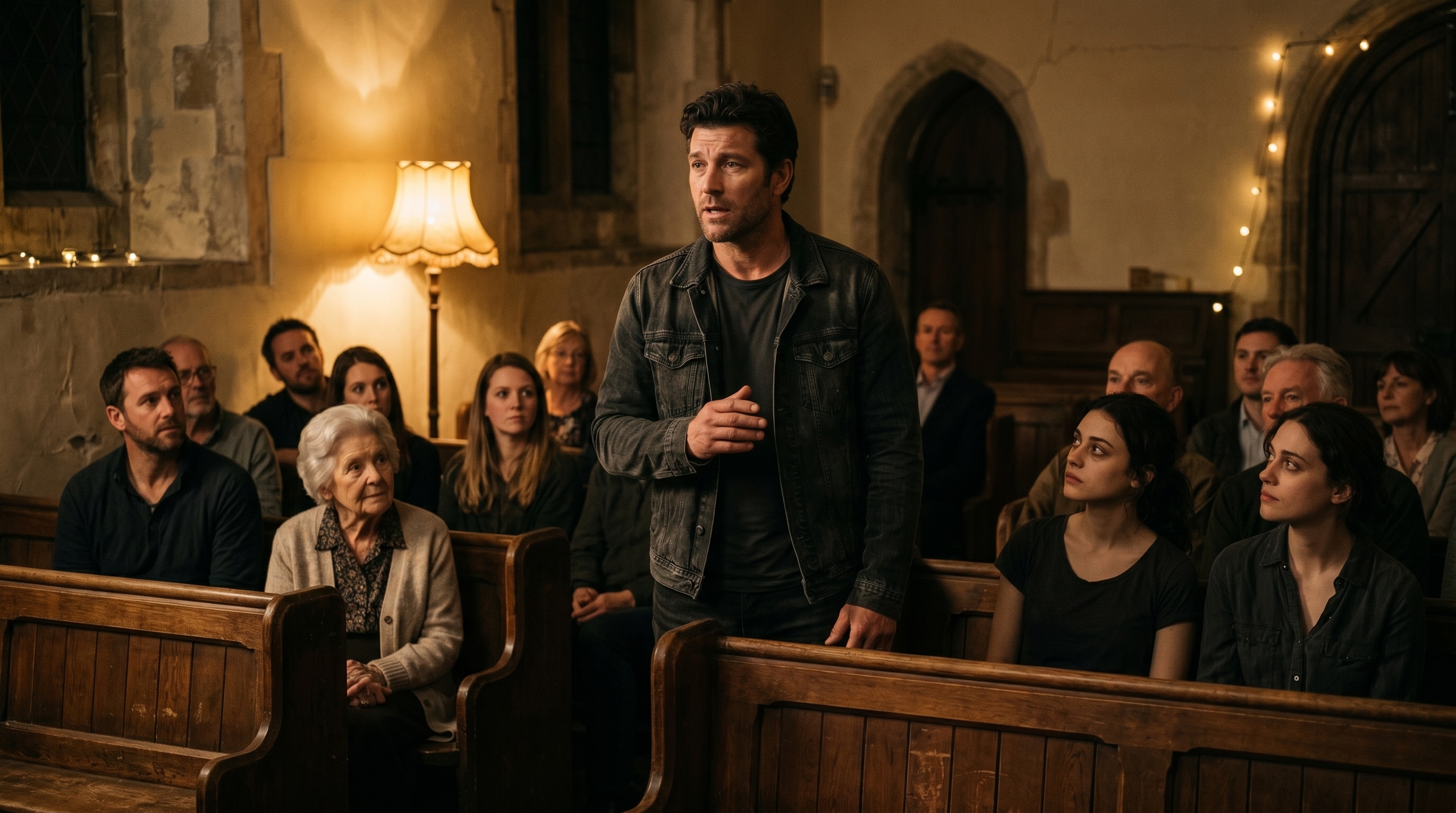
I once watched a man walk back into a burning situation that every instinct, every ounce of training, and every sensible person nearby told him to walk away from. He had nothing to gain by it. He was not being paid, not being ordered, not being watched by anyone whose opinion could help him. He went anyway, and when I asked him afterward why, he gave an answer that had nothing to do with strategy. He told me he simply could not have lived with himself otherwise. That answer has stayed with me for decades, because it is the kind of thing a person says only when something deeper than self-interest is steering the wheel. When I sat down to write The Hunter of Wolves, that was the kind of decision I wanted at the center of the book — and faith is what makes those decisions possible.
People sometimes assume that a novel with overt faith in it must wear that faith like a coat of paint, something applied to the surface after the real construction is done. I built this book the opposite way. Faith here is not the message tacked onto the end of the story. It is the engine under the hood, and if you listen, you can hear it running on every single page.
Faith in this book is not the moral tacked onto the end. It is the engine under the hood, and you can hear it running on every page.
Key Takeaways
- In The Hunter of Wolves, faith is not a theme laid over the plot — it is the force that actually drives the plot’s choices and turns.
- The protagonist’s faith is flickering and imperfect, which makes his courage costly and believable rather than easy.
- The story’s most important decisions only make sense as acts of faith; remove the belief and the choices become irrational.
- Faith reframes loss and failure as providence, turning the hero’s worst setbacks into the very means of his mission.
- Prayer functions as genuine cause-and-effect in the narrative, setting events in motion rather than merely commenting on them.
- A character’s relationship to faith — or willful refusal of it — is the real axis along which the cast divides.
- The faith-driven structure lets the book reach an ending most thrillers never even reach for.
Faith Is Not the Message of This Story — It Is the Engine
A story is really just a chain of choices and consequences. What makes a character compelling is not what happens to them but what they decide when it does. So when I wanted faith to genuinely shape The Hunter of Wolves, I knew I could not simply have people say faithful things. I had to let faith determine what they do — and then let the plot follow from there.
This is why nearly every hinge in the book is a decision that would be inexplicable without belief behind it. A detective keeps pursuing a case no one assigned him and his superiors have ordered him to drop. An old woman bakes cookies for strangers and prays over men she has never met. A small group of ordinary people, none of them remotely qualified, agree to attempt something far beyond their means. None of these are sensible moves. All of them are faithful ones. And every one of them sets the next stretch of the story in motion.
A Detective Running on a Flickering Wick
I did not want to write a hero whose faith was a fortress. That would have been false to everything I have witnessed, and frankly, it would have been boring. When we first meet Hunter Cristoff, his faith has been badly shaken by grief. He is a man whose inner flame has burned down so low it seems it might gutter out at any moment — and yet, mysteriously, it does not. Something keeps that smoldering wick alive that does not seem to belong to him at all.
A flickering wick is still a fire, and the whole story turns on the difference between a flame that is low and a flame that is out.
That distinction is the engine of his character. Cristoff is not brave because he is certain. He is brave because, even in his doubt, he chooses to trust the purpose pulling at him. I wanted readers to recognize themselves in that — to see that you do not need an unshakable faith to act faithfully. You need only a wick that has not quite gone out, and the willingness to keep walking toward the next thing you are asked to do.
The Decisions That Make No Sense Without It
Strip the belief out of this novel and watch what happens to the plot. The detective’s refusal to abandon a missing woman becomes mere obsession. His willingness to risk his career, his safety, and far more becomes recklessness. The decision a group of unequipped people make to go after someone trapped half a world away becomes simple foolishness.
But that is precisely the point I wanted to make through the story. Faith reorders what counts as reasonable. When a person truly believes that every soul matters, that they have been placed where they are for a purpose, and that the outcome rests in hands stronger than their own, then walking toward danger is not irrational at all. It is obedience. The plot of The Hunter of Wolves runs on that reordering. The characters keep making choices the world would call mistakes, and the story keeps proving those choices were the only ones that mattered.
When Loss Becomes Providence
Here is the part of the book closest to my own heart. Hunter Cristoff has lost almost everything that anchored him — and over the course of the story, the things he has lost become, strangely, the very means by which he is freed to do what he is called to do. His grief gives him a tenderness toward the missing and the trapped. His professional downfall removes the very obstacles that would have kept him in his lane.
I have lived long enough to distrust easy comfort, so I did not want to write a book that pretended faith makes the pain disappear. It does not. What faith does in this story is refuse to let the pain be the final word.
Faith did not spare Hunter his losses. It refused to let them be the end of the sentence.
That is how faith shapes the architecture of the plot itself. Setback after setback, which in another thriller would simply raise the stakes, here keep turning out to have been quiet acts of providence — doors closing so that the right door could open. The reader who is paying attention slowly realizes that nothing in the hero’s suffering has been wasted.
The Prayers That Move the Plot
In most novels, prayer is a moment of pause — a character collects themselves, and then the plot resumes. I wanted prayer in The Hunter of Wolves to be the opposite: a cause, not a comma. When Grace is moved to pray for a stranger, things happen. When she gathers a few faithful people and asks them to act, the entire second half of the book is set in motion by that gathering.
I made this choice deliberately, because it reflects what I have come to believe is actually true about how the world turns. The most consequential events are often traceable back to someone, somewhere, quietly doing the unseen work of intercession. In the story, the people on the front lines almost never know whose prayers are holding them up. But the reader knows. And once you see it, you cannot un-see how often the plot’s forward motion begins on its knees.
The Destination the Genre Rarely Reaches
A thriller usually ends with a reckoning — the guilty caught, the threat eliminated, the score settled. Faith pointed The Hunter of Wolves toward a different kind of ending. Without giving away where the story lands, I will say only this: because faith is the engine, the book is finally far more interested in whether the lost can be found than in whether the wicked can be destroyed. The most dramatic transformation in the novel happens not in a chase or a shootout but in a human heart that everyone, including its owner, had given up for lost.
A story driven by faith can reach for that. It can pursue mercy as hard as justice, and arrive somewhere that pure suspense, on its own, could never take a reader. That destination is not an accident of the plot. It is where faith was always going to lead.
Final Thought
If you take only one thing from The Hunter of Wolves, I hope it is this: faith is not what the characters talk about. It is what the characters do, and therefore it is what the story is. Take the faith out of this novel and the plot does not merely slow down — it stops, because there is no longer any reason for anyone to make the choices that move it. I did not write a thriller and then add belief to it. I wrote a story about people whose belief made them act, and let everything else follow. That, I have come to think, is also a fair description of a life worth living.
Take the faith out of this novel and the plot does not slow down. It stops.
Discussion Questions
- The story argues that faith reorders what counts as “reasonable.” Have you ever made a decision that looked foolish to others but made complete sense given what you believed?
- Hunter Cristoff acts faithfully despite a faith that is shaken and flickering. Is imperfect, doubting faith more relatable to you than unshakable certainty? Why?
- The novel turns the hero’s losses into the means of his mission. Looking back, can you see places where your own setbacks opened a door that otherwise would have stayed shut?
- In the book, prayer is a cause that moves the plot, not just a pause within it. How does that compare with the role prayer plays in your own life or worldview?
- The story reaches for mercy as much as justice. Do you find a faith-driven ending more satisfying than a conventional reckoning, or less? What does your answer reveal?
Frequently Asked Questions
Does faith actually drive the plot, or is it just a backdrop? It drives the plot. Nearly every major turn in the story is set in motion by a decision that only makes sense as an act of faith — remove the belief, and the characters would have no reason to act.
Can readers who aren’t religious still follow and enjoy the story? Absolutely. Faith functions here as the characters’ motivation, the way ambition or revenge motivates other thrillers. You do not have to share the belief to understand exactly why it makes these people do what they do.
Is Hunter Cristoff written as a flawless Christian hero? No, and that was intentional. His faith is wounded and uncertain for much of the book. His courage is meaningful precisely because it is exercised through doubt and grief rather than in spite of having none.
How does faith — or the lack of it — affect the villains? The antagonists are largely defined by a willful blindness, a refusal to acknowledge realities they would rather deny. In the world of the book, that refusal is its own kind of choice, and it shapes their fate as surely as faith shapes the heroes’.
Does the story suggest that faith guarantees an easy, happy outcome? Not at all. The hero suffers real and lasting loss. What faith provides in the story is not the removal of pain but the assurance that the pain is not meaningless and not the end — that even loss can be woven into a larger purpose.
Sources
- self-interest — https://dictionary.apa.org/self-interest
- faith — https://www.britannica.com/topic/faith
- consequences — https://www.merriam-webster.com/dictionary/consequence
- character — https://dictionary.apa.org/character
- grief — https://dictionary.apa.org/grief
- doubt — https://www.merriam-webster.com/dictionary/doubt
- obedience — https://www.merriam-webster.com/dictionary/obedience
- providence — https://www.britannica.com/topic/providence-theology
- prayer — https://www.britannica.com/topic/prayer
- mercy — https://www.merriam-webster.com/dictionary/mercy
- justice — https://plato.stanford.edu/entries/justice/
- suspense — https://dictionary.apa.org/suspense